
Infrastructure education
What is infrastructure investing?
Infrastructure investing is owning a part of the essential assets and physical systems that underpin economic activity – the networks that move people, energy, water, data, and waste.
The long asset lives, non-discretionary demand, regulated revenues and high barriers to entry, make it one of the most resilient asset classes available.
Driven by reliable demand and predictable cashflows, investing in infrastructure offers investors a lower risk way to diversify and achieve stable income with long-term growth potential across all market cycles.
Why invest in unlisted infrastructure?
Reliable income
Long-term assets with contracted revenue streams provide cash flow visibility, supporting regular distributions that compound steadily over time.
Inflation protection
Built-in inflation protection as regulated assets increase prices when costs rise, protects real earnings throughout the asset lifecycle.
Capital preservation
Limited competition, high barriers to entry and regulated return frameworks structurally insulate infrastructure from economic cycles – preserving capital through periods of broader market stress.
Low correlation and volatility
The non-discretionary demand for essential assets means that returns have a low correlation with equities, bonds and real estate. Unlisted infrastructure benefits from less volatility as investments are not subject to short-term market sentiment like listed infrastructure.
Long-term growth potential
Decarbonisation, digitalisation and demographic changes are driving sustained demand for new and upgraded infrastructure, creating a compelling long-term opportunity.
Portfolio diversification
Reliable income, inflation protection, low correlation to traditional asset classes and long-term growth potential mean unlisted infrastructure addresses multiple investment objectives – making it an essential allocation in any balanced portfolio.

Not all infrastructure investment managers are the same
Infrastructure spans different sectors, risk profiles and markets. The difference between an average and a great infrastructure investment is substantial, and it compounds over a 10 to 20-year hold period.
Managers differ in experience, deal flow, fee structures, transparency, governance, investment strategies and their ability to navigate challenges when they arise. Recognising these differences and conducting your own due diligence before selecting the right manager is essential to unlocking the true potential of the asset class.
Unlisted infrastructure on the risk-return spectrum
Unlisted infrastructure can be a beneficial addition to an investment portfolio, but not all infrastructure assets carry the same risk.
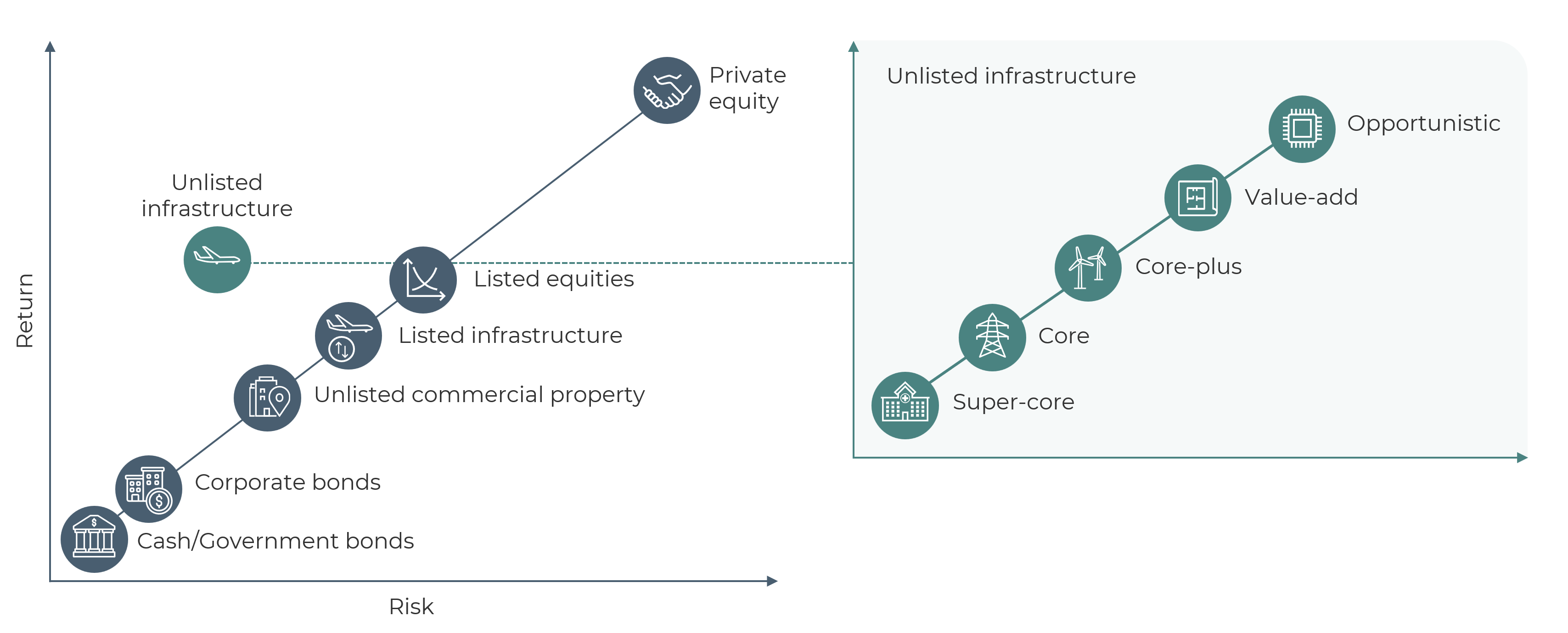
Super-Core
Fully contracted or regulated assets with minimal demand exposure and high distribution yield.
Examples: Regulated electricity transmission networks, PPP hospital and school facilities.
Core
Monopolistic assets with revenues linked to broad economic activity, benefiting from essential-service status and natural monopolies.
Examples: Major international airports, metropolitan water utilities, principal seaports.
Core-Plus
Assets with some demand or merchant risk alongside a core regulatory base, offering exposure to structural growth themes.
Examples: Toll Roads, contracted renewable energy generators, mid-market fibre networks.
Value-Add
Assets requiring operational transformation or capital expenditure programs where active management is central to the return thesis.
Examples: Brownfield airports undergoing expansion, assets with greenfield development.
Opportunistic
Development-stage or complex restructuring situations with material construction, permitting, and regulatory risk.
Examples: Early-stage renewable energy developments and digital infrastructure platforms.
Frequently asked questions

Looking to invest in unlisted infrastructure?
Discover how our range of funds could help you achieve your investment goals.